Remaking the World: How 1776 Created the Post-Christian West
Andrew Wilson’s 'Remaking the World' traces how the key events of 1776 rebranded Christian theology into self-evident secular convictions.
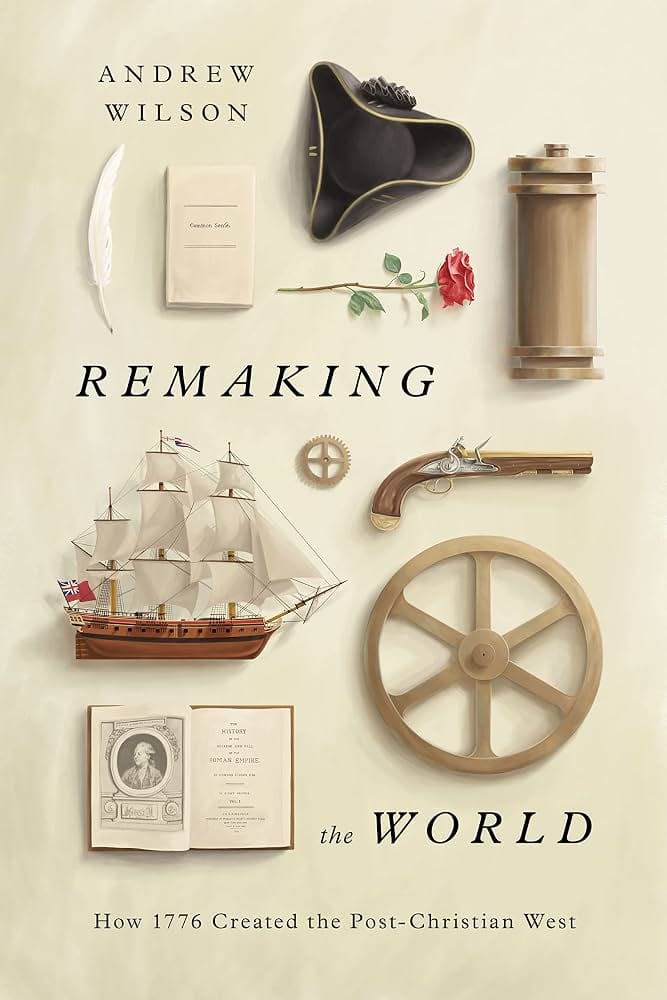
In the summer of 1776, laid up with gout, Benjamin Franklin made a small edit to a draft he'd been handed. Thomas Jefferson had written that certain truths about human equality were "sacred and undeniable." Franklin crossed out the last two words and wrote "self-evident." It's a throwaway moment in most retellings of the founding, the kind of copyediting detail that gets a footnote if it gets anything. Andrew Wilson builds an entire argument out of it, and by the time you reach the end of Remaking the World, you understand why. The edit is a perfect miniature of what Wilson thinks happened to the whole Western world in and around that single year: a set of convictions that were originally theological got rebranded as rational, and two and a half centuries later we've largely forgotten there was ever a rebranding at all.
That's the real spine of the book, and it's a sharper and more interesting one than the cover's mnemonic lets on. Wilson's organizing device is the acronym WEIRDER—Western, Educated, Industrialized, Rich, Democratic, Ex-Christian, Romantic—borrowed and extended from the "WEIRD" psychology literature, and he gives each letter its own chapter and its own point of origin in 1776: Cook's voyages and Enlightenment cartography for the Western, Jefferson and the Declaration for the Democratic, Watt's steam engine for the Industrialized, Rousseau and the Sturm und Drang for the Romantic, and so on. It's a tidy structure, maybe too tidy at points—seven letters mapped onto seven revolutions mapped onto ten events in a single calendar year is the kind of symmetry that historians should regard with some suspicion, and Wilson is not naive about this. He's upfront that 1776 is a synecdoche rather than a single causal hinge, a year that lets him narrate a much longer set of transformations (globalization, the Enlightenment, industrialization, the rise of post-Christianity, Romanticism) through a manageable cast of characters who all happened to be alive and busy at the same moment. Once you grant him that framing device, the payoff is substantial: chapter after chapter, he's not just cataloguing what changed but showing how those changes still structure categories we treat as neutral—rights, freedom, authenticity, progress.
The Ex-Christian chapter is where this argument earns its keep, and where the Franklin anecdote does its work. Wilson's case, echoing Tom Holland and Larry Siedentop more than he echoes anyone hostile to the West, is that the modern Western conscience is not so much post-Christian as ex-Christian in the way a divorced spouse is ex-married: still shaped by the relationship it thinks it's left. Human rights, equality, the presumption that suffering matters and the weak deserve protection—none of this was self-evident to most human societies across most of history, and Wilson is happy to let Nietzsche make the point on his behalf, since Nietzsche made it more bitterly and more accurately than most Christian apologists have managed since. What's genuinely useful here is that Wilson doesn't turn this into a triumphalist gotcha. He's just as interested in the discomfort it should cause Christians as the discomfort it should cause secular readers: if the tree bore this much fruit, why did the West feel the need to cut it down, and why has the fruit mostly survived the felling? That question animates the whole second half of the book more than any culture-war point-scoring does.
Where the book is most fun—and "fun" really is the right word, because Wilson writes like someone who enjoys his own research—is in the density of incident he can hang on each theme. You get David Hume dying an unrepentant skeptic while his biographer has a private crisis of faith at the bedside; you get Rebecca Protten, a formerly enslaved Moravian evangelist, praying her way out of a Caribbean prison two days before her prophesied deliverer walks through the door; you get John Newton writing "Amazing Grace" in the same decade he was still trading in human beings, and a former slave named Olaudah Equiano converting to the faith of the people who enslaved him and somehow meaning it. Wilson trusts these stories to carry theological weight without editorializing them into submission, and the book is better for it. It also means the two closing chapters, where he finally turns from history to argument and asks what all this means for Christians navigating a "postsecular" West, land with more force than they would in a book that had spent 250 pages making its case in the abstract. His answer there—grace as the antidote to a status- and identity-obsessed culture that's forever asking "have I done enough," freedom reconceived as liberation from the self and not just from external tyranny, truth grounded in the Word rather than in reason's futile attempt to justify itself—isn't a strategic five-point plan for church renewal, and he says so explicitly. It's closer to a reminder that revival has always come from obedience rather than tactics, which will read as either wise or maddeningly unambitious depending on what kind of reader you are.
At just under 300 pages, the book asks for real but not extravagant commitment, and it rewards the effort more than most single-thesis popular histories do, mostly because Wilson resists the temptation to squeeze every chapter into the same mold. If you want to understand why a culture that has never been more free, more comfortable, or more skeptical of institutional religion still can't shake off categories—rights, dignity, progress, even the shape of its own guilt—that only make sense against a Christian background, this is as good and as readable an account as you'll find. Just don't expect the acronym on the cover to do justice to how much is actually going on underneath it.